Welcome to Staatsburgh State Historic Site's blog! Learn more about the Gilded Age home of Ruth and Ogden Mills!
Showing posts with label Ruth Livingston Mills. Show all posts

Saturday, July 4, 2026

Ruth Livingston Mills and the Use of Revolutionary War Iconography in Staatsburgh’s Interior Decoration

When the mansion at Staatsburgh was remodeled by Ogden and Ruth Livingston Mills in 1895, it had been more than a century since the Revolutionary War and the formation of the United States. Yet the history of Staatsburgh was closely tied with the late 18th century and the early years of this nation. The estate was originally founded in the 1790s by Ruth’s great-grandfather, Morgan Lewis. Over 100 years later, when the mansion was remodeled and redecorated, the interior décor included countless nods to Ruth’s family and key figures who were involved in the Revolutionary War and the creation of the fledgling United States. Ruth Livingston Mills was a top society hostess during the Gilded Age. Most leaders of society had mansions decorated in the French aristocratic style, but Ruth also leaned on her Revolutionary War heritage to further cement her legitimacy as the potential next “Queen” of society.


As we celebrate the Semiquincentennial of the nation in 2026, this essay will explore the ways that Ruth Livingston Mills leveraged her Revolutionary War heritage in the interior decoration of Staatsburgh. This messaging appears throughout the entire mansion, but this essay will focus on the library, which has the largest and most varied concentration of Revolutionary War collections. Since Staatburgh was Ruth’s ancestral home, it was the ideal location to showcase her venerable pedigree and show her guests the importance of her illustrious heritage.

Tuesday, December 9, 2025

Gilded Age Travel: The Mills Family, Friends & Servants

During the 2025 holiday season, the mansion was decorated with a travel theme to recognize the importance of travel to the Mills family, their servants, and friends.  Rooms featured specific countries where family or friends traveled as well as countries reflecting the origins of collections within the house.  Ruth and Ogden Mills traveled to Europe nearly every spring.  They often went to visit family, but they also traveled to see landmarks, museums, and the natural beauty of other lands.  Technological advancements during the Gilded Age created the ability for wealthy Americans to travel for leisure purposes and as the era progressed, more middle class families also began to travel for vacations. 

World Map, Circa 1900

Saturday, September 27, 2025

Eulabee Dix: Gilded Age Miniaturist

In 2023, the site received an amazing donation from a Mills family descendant, Dorothy Fell Farrelly, a granddaughter of Dorothy Fell Mills, widow of Ogden Livingston Mills. She and her husband Louis donated three miniature portraits of family members including Margaret Lewis Livingston, Darius Ogden Mills, and a painting never before seen by us, of Ruth Livingston Mills. After some research, we were able to find out that the artist who painted the portrait of Ruth was a woman named Eulabee Dix (1878-1961), an artist who specialized in miniature portraits.

"Mrs. Ogden Mills" by Eulabee Dix, 1907, Watercolor on Ivory

Saturday, November 23, 2024

Gilded Age Christmas Gifts: The "Mystery Dollhouse" from FAO Schwarz

Long before children in the 20th century were requesting a Barbie dreamhouse for Christmas, girls in the 1890s had dreams of receiving dollhouses that were no less elaborate than what we might see today! If you visit Staatsburgh during ‘A Gilded Age Christmas’ this year, keep your eyes open for a large dollhouse. The dollhouse was first put on display in 2023 and then again this year as a representation of the type of Christmas gifts one of the Mills daughters may have received.

1890 "Mystery dollhouse," donated by Joseph and Susan Feeks in 2023

Tuesday, January 2, 2024

Gilded Age Opera Wars: The Academy of Music vs. The Metropolitan Opera

One of the major plot points running through the second season of HBO’s The Gilded Age was the clash between the Academy of Music and the Metropolitan Opera.  Although the battle between the two opera houses was historically documented, the conflict was amplified on the show for maximum drama.  The Academy of Music had been New York’s established opera house since the 1850s and only those with “old money” and connections had boxes.[1]  With the influx of “new money” into New York, many families were unable to get a box due to the academy’s exclusivity and lack of space.  As a result, families with “new money” decided to pool their resources and build a brand-new opera house, the Metropolitan Opera.  When the Metropolitan Opera opened its doors for the very first time in 1883, they did so on the same exact night as the opening for the Academy of Music.  This set up the two opera houses for a clash where only one would triumph in the end! But which opera house did Ruth & Ogden Mills choose?  Read on to find out!

Puck Magazine, a publication often using humor or satire to depict current events, showcased the clash in the October 31, 1883 edition, Artist Joseph Keppler, Library of Congress.

Friday, November 24, 2023

Is That Napoleon?

That's Napoleon.
(ML.1974.242)
No, that's not Napoleon.

Hanging in Staatsburgh's library, the life-size portrait of Staatsburgh's founder, Morgan Lewis, dressed an early 19th century military uniform, often prompts the question "Is that Napoleon?" 

While Ruth Mills' great-grandfather is not the French emperor, there are certainly reminders of Napoleon Bonaparte throughout the house. Tucked away in the southwest corner of Staatsburgh's library is a leather-bound, four-volume set titled Napoleon Bonaparte: A Life. Sitting upon Mrs. Mills' desk in her boudoir is a small brass sealing wax stamp crowned with a bust of Napoleon Bonaparte. Besides it, there sits a small tortoise box with a cameo of Napoleon Bonaparte. Outside of the guestrooms for unmarried ladies upstairs, hung among the portraits of American presidents such as George Washington and Theodore Roosevelt, hangs a print of Jacques-Louis David's Napoleon Crossing the Alps.

In anticipation of the upcoming Napoleon Bonaparte biopic, Napoleon, starring Joaquin Phoenix as the titular emperor, we wanted to share some of Staatsburgh's own connections to the wider Bonaparte family. For a woman who vied to be Queen of New York Society, Ruth Mills seemed to surround herself with images of French royalty. Yet her and her family's ties to the Bonaparte family went beyond interior decoration. Several generations of Ruth Livingston Mills' family had connections to the famous French imperial family, reaching from the gilded palaces of Paris to the American Wild West.

Thursday, March 16, 2023

Suffragists, Socialists & Socialites: Women's History Month

March is Women's History Month - a month-long celebration of history-making women and their accomplishments! Here at Staatsburgh, there are plenty of stories of remarkable women, groundbreaking achievements, and their contributions to local, national and international history.
 

François Flameng. Ruth Livingston Mills.
1909. Oil on Canvas. 
Of course we have to start off Women's History Month with our very own Ruth Livingston Mills. 

As a woman born into New York's high society, Mrs. Mills attended many charity events and contributed money to a variety of causes. Charity was one avenue for these ambitious society women to focus their energies, since many were not allowed careers in the era. According to newspapers, one of those causes was the fight for female suffrage - the right to vote! Activists and reformers such as Ida B. Wells, Dr. Mary Walker, and Jane Addams campaigned across the county for the right to vote during the Gilded Age.

Friday, December 30, 2022

Masquerade! Paper Faces on Parade!

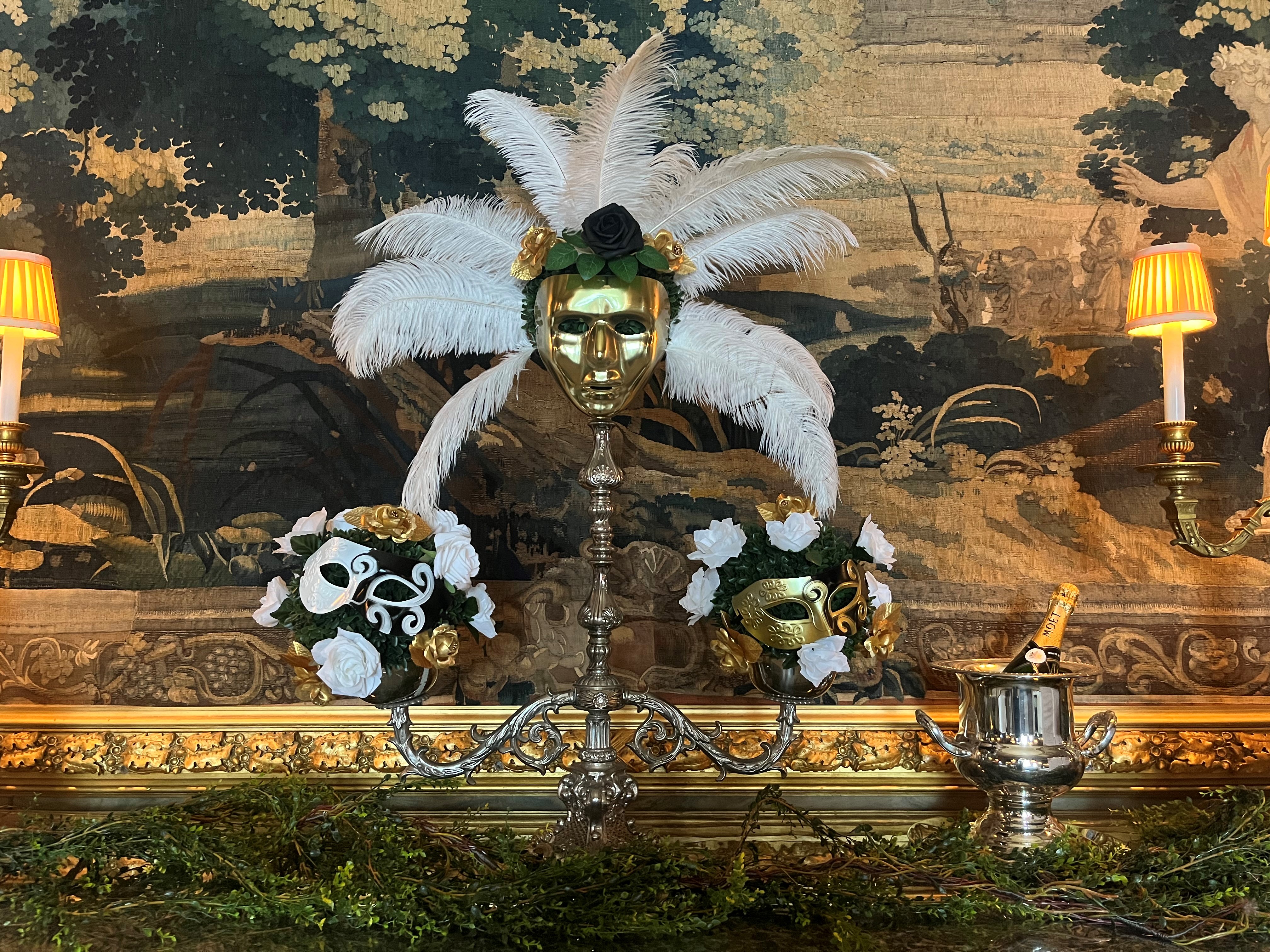
The Christmas season is always a grand affair at Staatsburgh!  The site has elaborate decorations that evoke the decadence and over-the-top nature of the Gilded Age. Quite often, the holiday decorations are aligned with a theme and in 2022 that theme was masquerade.  Masks adorned various Christmas trees and tables throughout the mansion and the strains of Phantom of the Opera's 'Masquerade' could be heard in the dining room (hence the borrowed lyric in the title of this essay.)  Masquerade balls evoke a sense of mystery and opulence that was most commonly associated with 16th-century Venice and the Carnival. Since wearing a mask could act as a disguise, there was an element of thrill and intrigue about not knowing the identity of your dance partner.  Although masquerade balls fell out of fashion the following century, they became popular again in 18th-century Europe.  Given that Gilded Age décor frequently copied 18th-century European tastes and styles, it was only natural that masquerade balls were once again part of entertaining .  

Banquet table in the Dining Room, December 2022

Tuesday, November 29, 2022

"My Dear Gitty,": What Margaret Lewis Livingston's Letters to her Daughter Reveal about the Mother of 12

Could letters serve as a gateway to the mind?  To a person's innermost thoughts and feelings?  Is it possible to peer into the psyche of a person by reading their letters?  Maybe, maybe not.  In retrospect, we cannot know how much a person pours of themselves into their correspondence.  Are they truthful or reserved?  Do they have an agenda? Did the writer consider their legacy when composing letters that would potentially shape the way they are remembered?  All of these questions come into play when historians explore primary sources such as correspondence.  

At Staatsburgh, we often lament the lack of letters and personal papers left behind by the Mills family.  While the family donated estate lands, outbuildings, the mansion and its furnishings to New York State, any personal papers were removed by the family.  Letters from Ruth and Ogden Mills do exist in the archival collections of the recipients and there is always more to find.  Even though correspondence to or from Ruth and Ogden Mills is thin, a treasure trove of letters from Ruth's grandmother, Margaret Lewis Livingston (1780-1860) exists and were recently annotated and published by Mary Mistler.  This essay will share some of the insights about Margaret's life that can be gleaned from reading through all of these letters.

The annotated book of letters from Mary Mistler and Staatsburgh's typewritten transcripts of the letters.  Mistler's book is currently available for purchase in Staatsburgh's gift shop!

Thursday, March 31, 2022

Staatsburgh & The Gilded Age

As the stewards of a site that interprets the Gilded Age, we were very excited to see an entire television series dedicated to the era.  We were especially interested because the show was created by Downton Abbey mastermind, Julian Fellowes who is known for the efforts he puts into the historical details and accuracy of his shows and movies.  The first season of HBO's The Gilded Age depicted 1882 New York and aired from January - March 2022; a second season is forthcoming.  The show brought the era to life with magnificent costuming, sets, and a dramatization of the clash between old and new monied elites.  In addition to this central clash of values, the show also depicted the life of the black elite in Brooklyn, the plight of servants, and the ways new technology was about to revolutionize the country.  Although the main characters were fictional, there were several real historical figures mixed in such as Mrs. Astor, Ward McAllister, and Mrs. Fish among others.  

Photo: HBO

Tuesday, November 30, 2021

Radium, Perms & Painted Knees: Beauty Fads of the 1920s

 With the generous support of the Friends of Mills at Staatsburgh, our site has hosted a research intern from Bard College this summer. Celka Rice, a literature major at Bard, has researched various aspects of 1920s fashion, helping Staatsburgh explore the possibility of presenting accurate costumed interpretation during the 100th anniversary of the Roaring ‘20s. Although Celka’s interdisciplinary studies cover a broad background which include history, anthropology, art history, classics, and photography, the internship called upon another of her diverse interests: her expertise in vintage clothing and fashion history. For her summer project, Celka has researched retail sources for reproduction and vintage clothing, and has written three blogs on fascinating 1920s fashion topics.  This essay, the third, explores a variety of unique beauty fads popularized in the 1920s.

Illustrated by Georges Lepape, Vogue, February 1, 1925

Friday, July 30, 2021

Little Purple Flowers

From Ruth Mills' dinner parties and Broadway murder trials to French battlefields and President Roosevelt's inaugurations, Marie Louise was fashionable everywhere.

Meet Marie Louise ... no, not her - the flower!
Courtesy of HVNY.

Named for the second wife of Napoleon, the fragrant double Parma "Marie Louise" violet was at the height of fashion for generations during the Gilded Age. From the late-1800s to the mid-1900s, violets were among the world's most popular flowers and the mecca for the little purple flowers was none other than Dutchess County! The stretch of the Hudson Valley from Red Hook down to Poughkeepsie was known as the Violet Belt in the United States, with Rhinebeck - just 10 minutes north of Staatsburgh - the Violet Capital of the World.

Tuesday, October 13, 2020

Remembering Ruth Livingston Mills a Century After her Death

Today, October 13, 2020, marks the 100th anniversary of the death of Ruth Livingston Mills, the long-time matriarch of Staatsburgh, born in 1855.  Ruth’s legacy can be found in her descendants, the preservation of her Staatsburgh mansion, and the surrounding park that bears her name.  Upon announcing her death, The New York Times reported, “Since the death of Mrs. William Astor no leader of New York society has more nearly approached the position of social arbiter than Mrs. Mills. Her characteristics as a hostess never altered; she did not believe in easily letting down the bars to newcomers or to new methods and manners of entertaining, one critic of her small invitation list during a certain Newport season asserting that she was determined to reduce the ‘400’ to ‘150.’”  

A September 12th article in a Pittsburgh newspaper reported that Mrs. Ogden Mills was due to spend the late autumn at Staatsburgh though she was currently in Paris with her daughter, the Countess of Granard. Mr. Mills was on his way to join her.  Alas, Mrs. Mills was never again going to welcome guests to her beloved Staatsburgh.


Friday, August 28, 2020

Traces of Edith Wharton's House of Mirth at Staatsburgh

This blog is authored by David Bayne who served as the furniture conservator for the New York State Bureau of Historic Sites from 1992 until his retirement in early 2020.  David spent eleven years as a musical instrument and furniture maker before taking the Smithsonian Institution's Furniture Conservation Training Program and becoming a conservator.  David conserved many pieces of furniture at Staatsburgh including the French armoire discussed in this blog from 2018.

Essay author David Bayne

Thursday, July 2, 2020

Summer at Knebworth House

During summer, it is not unheard of for wealthy or even middle class families to rent a home for the season.  But could you imagine renting this house?  Well, in 1909, that is exactly what Ruth & Ogden Mills did.

Knebworth House, Hertfordshire, England

Tuesday, June 9, 2020

A 1901 Epidemic at Staatsburgh

In this time of COVID-19, it is instructive to note that the world has been plagued (if you will) with epidemics throughout history. The Gilded Age was no exception. In the 19th and early 20th centuries, as in past centuries, waves of yellow fever, smallpox, cholera, diphtheria, typhoid fever, polio and scarlet fever brought fear and death.


Friday, May 8, 2020

Dining on the Titanic - Part III

Parts I and II of the Dining on the Titanic blog began by saying that we talk a lot about the Titanic at Staatsburgh. Staatsburgh’s owners, Ruth and Ogden Mills, planned to sail on the ship’s second voyage, one the doomed liner was never to make. The people who traveled first-class on the Titanic included people in the Millses’ social circle, as well as Mrs. Mills’ cousin, John Jacob Astor. The Millses’ connection to the Titanic led us to create “Tales of the Titanic,” a themed tour that we offer each spring. The Titanic has also been a theme for some of the talks at our Tea and Talk series. This 3-part Dining on the Titanic blog essay reproduces the 2016 Tea Talk of the same title.

As in Parts I and II, this essay will start with acknowledging the primary source for the Tea Talk, the delightful book, Last Dinner on the Titanic: Menus and Recipes from the Great Liner, by Rick Archbold and Dana McCauley. Featuring sound scholarship, good writing, and beautiful illustrations, the book is a great read.


Thursday, April 23, 2020

Dining on the Titanic - Part II

Dining on the Titanic Part I began by saying that we talk a lot about the Titanic at Staatsburgh. Staatsburgh’s owners, Ruth and Ogden Mills, planned to sail on the ship’s second voyage, one the doomed liner was never to make. The people who traveled first-class on the Titanic included people in the Millses’ social circle, as well as Mrs. Mills’ cousin, John Jacob Astor IV. The Millses’ connection to the Titanic led us to create “Tales of the Titanic,” a themed tour that we offer each spring. The Titanic has also been a theme for some of the talks at our Tea and Talk series. This 3-part Dining on the Titanic blog essay series reproduces one of the Tea Talks: “Dining on the Titanic.”

The primary source for the Tea Talk was the delightful book, Last Dinner on the Titanic: Menus and Recipes from the Great Liner, by Rick Archbold and Dana McCauley. Featuring sound scholarship, good writing, and beautiful illustrations, the book is a great read. 


Wednesday, April 15, 2020

Dining on the Titanic - Part I

We talk a lot about the Titanic at Staatsburgh. Staatsburgh’s owners, Ruth and Ogden Mills, planned to sail on the ship’s second voyage, one the doomed liner was never to make. The Millses connection to the Titanic led us to create “Tales of the Titanic,” a themed tour that we offer each spring. The Titanic has also been a theme for some of the talks at our Tea and Talk series. In this blog and ones to follow, we’ll reproduce one of the Tea Talks: “Dining on the Titanic.”

The primary source for the talk was the delightful book, Last Dinner on the Titanic: Menus and Recipes from the Great Liner, by Rick Archbold and Dana McCauley. Featuring sound scholarship, good writing, and beautiful illustrations, the book is a great read.

Tuesday, April 14, 2020

Music of the Gilded Age at Staatsburgh


Staatsburgh has been working with Dr. Christopher Brellochs, Chair of the Academy of Music at Dutchess Community College, on programs about Gilded Age music.  Dr. Brellochs has been researching Gilded Age music and performing at various Gilded Age sites throughout the Hudson Valley region.  He has explored the connections between the Mills family and music, and especially their relationship with the Metropolitan Opera.  Although his upcoming tea talk and music programs are postponed, please enjoy this preview of his research into the music that Ruth & Ogden would have enjoyed at the opera.

Dr. Christopher Brellochs