Welcome to Staatsburgh State Historic Site's blog! Learn more about the Gilded Age home of Ruth and Ogden Mills!
Showing posts with label Maria Reynolds. Show all posts

Saturday, July 4, 2026

Ruth Livingston Mills and the Use of Revolutionary War Iconography in Staatsburgh’s Interior Decoration

When the mansion at Staatsburgh was remodeled by Ogden and Ruth Livingston Mills in 1895, it had been more than a century since the Revolutionary War and the formation of the United States. Yet the history of Staatsburgh was closely tied with the late 18th century and the early years of this nation. The estate was originally founded in the 1790s by Ruth’s great-grandfather, Morgan Lewis. Over 100 years later, when the mansion was remodeled and redecorated, the interior décor included countless nods to Ruth’s family and key figures who were involved in the Revolutionary War and the creation of the fledgling United States. Ruth Livingston Mills was a top society hostess during the Gilded Age. Most leaders of society had mansions decorated in the French aristocratic style, but Ruth also leaned on her Revolutionary War heritage to further cement her legitimacy as the potential next “Queen” of society.


As we celebrate the Semiquincentennial of the nation in 2026, this essay will explore the ways that Ruth Livingston Mills leveraged her Revolutionary War heritage in the interior decoration of Staatsburgh. This messaging appears throughout the entire mansion, but this essay will focus on the library, which has the largest and most varied concentration of Revolutionary War collections. Since Staatburgh was Ruth’s ancestral home, it was the ideal location to showcase her venerable pedigree and show her guests the importance of her illustrious heritage.

Friday, April 24, 2026

Gilded Age Love Stories: Chauncey Depew's Second Chance at Love

There were many sensational love stories and romances during the Gilded Age, and there is no need to look further than the Mills family and Staatsburgh’s guests to find some of the people who were part of them. As we research all of the approximately 150 individuals who signed Staatsburgh’s guestbook between 1899 and 1908, many interesting personalities and stories have emerged.  One of them involves Hudson Valley native and US Senator Chauncey Depew who found love in both his first and second marriages.  Many of Staatsburgh’s guests were involved in politics, but it is noteworthy to mention that Depew was the only sitting US Senator to sign Staatsburgh's guestbook when he visited in September 1900. Chauncey Depew was elected as a Senator from New York in 1899 and then re-elected in 1905.

Chauncey Depew (1834-1928), circa 1901
Image: Library of Congress


Tuesday, December 9, 2025

Gilded Age Travel: The Mills Family, Friends & Servants

During the 2025 holiday season, the mansion was decorated with a travel theme to recognize the importance of travel to the Mills family, their servants, and friends.  Rooms featured specific countries where family or friends traveled as well as countries reflecting the origins of collections within the house.  Ruth and Ogden Mills traveled to Europe nearly every spring.  They often went to visit family, but they also traveled to see landmarks, museums, and the natural beauty of other lands.  Technological advancements during the Gilded Age created the ability for wealthy Americans to travel for leisure purposes and as the era progressed, more middle class families also began to travel for vacations. 

World Map, Circa 1900

Saturday, September 27, 2025

Eulabee Dix: Gilded Age Miniaturist

In 2023, the site received an amazing donation from a Mills family descendant, Dorothy Fell Farrelly, a granddaughter of Dorothy Fell Mills, widow of Ogden Livingston Mills. She and her husband Louis donated three miniature portraits of family members including Margaret Lewis Livingston, Darius Ogden Mills, and a painting never before seen by us, of Ruth Livingston Mills. After some research, we were able to find out that the artist who painted the portrait of Ruth was a woman named Eulabee Dix (1878-1961), an artist who specialized in miniature portraits.

"Mrs. Ogden Mills" by Eulabee Dix, 1907, Watercolor on Ivory

Friday, June 27, 2025

Groundbreaking Women in the Guestbook: Eleonora Randolph Sears

Since receiving the amazing gift of an original Staatsburgh guestbook in 2017, the site has been researching all of the people who signed its pages. The guestbook covers the years 1899-1908 and includes approximately 150 individuals who visited Staatsburgh. There are many different people who signed the guestbook including relatives, friends, and neighbors of the Mills family as well as politicians, businessmen, sportsmen & women, and even the President’s daughter! This essay will look at one of the remarkable and barrier breaking women who signed the guestbook, Eleonora Randolph Sears (1881-1968).


Eleonora Randolph Sears, circa 1901, Bain News Service

Cover of Staatsburgh's guestbook dating from 1899-1908

Wednesday, May 28, 2025

Hidden Treasures of the Collection: "Mehemet Effendi, Ambassadeur Turc, arrive aux Tuileries, 21 mars 1721"

The walls of Staatsburgh’s drawing room are covered with many paintings that are nearly impossible to examine from the tour carpet. Continuing with our “Hidden Treasures of the Collection” series, this essay will take a closer look at the painting seen below, which is on the south wall of the drawing room. The oil on canvas painting depicts Mehmet Effendi, the Turkish Ambassador, and his entourage visiting Paris for the first time to have an audience with King Louis XV. It is one of many objects in the collection that is French or depicts France.

Painting in the style of Charles Parrocel, "Mehmet Effendi, the Turkish Ambassador, Entering the Tuileries to go to his audience with the King, March 21, 1721," Staatsburgh State Historic Site, NYS OPRHP

Friday, February 28, 2025

A Whole Lotta Bull: Love, War & Gossip in the Gilded Age

There were many sensational love stories and romances during the Gilded Age, and there is no need to look further than Staatsburgh’s guests to find some of the individuals involved in them. As we have been researching the approximately 150 individuals who signed the guestbook, several interesting stories and personalities have emerged.  The story of Henry Worthington Bull and Maud Livingston is just one of those stories.  This story reveals the tale of a broken-hearted young woman who lost her fiancé only to later fall in love with his close friend.

Henry W. Bull (1874-1958)


Tuesday, December 31, 2024

Uncle Ogden: Ogden Livingston Mills & the Sands Children

Ogden Livingston Mills (1884-1937) was many things including a lawyer, politician, husband, and guardian. At Staatsburgh, we often mention that Ogden Livingston Mills did not have biological children in order to explain why his sister inherited the house after his death. However, we don’t usually get a chance to talk about the ways that Ogden Livingston (O.L.) Mills was a father figure to several individuals in his life. In 1914, he was named one of two guardians for two young siblings, Anne Barbara Sands and George Winthrop Sands, along with their grandmother, Anne Harriman Sands Rutherfurd Vanderbilt. The children were the orphaned niece and nephew of his wife Margaret Rutherfurd. Ten years later, O.L. also became a stepfather,[1] and the children all affectionately referred to him as “Uncle Ogden.” In order to understand this aspect of O.L.’s life, let us take a look at O.L.’s history as a guardian for the Sands children and the connection between the Mills family and the Sands family.
 
Ogden Livingston Mills, 1915

Saturday, November 23, 2024

Gilded Age Christmas Gifts: The "Mystery Dollhouse" from FAO Schwarz

Long before children in the 20th century were requesting a Barbie dreamhouse for Christmas, girls in the 1890s had dreams of receiving dollhouses that were no less elaborate than what we might see today! If you visit Staatsburgh during ‘A Gilded Age Christmas’ this year, keep your eyes open for a large dollhouse. The dollhouse was first put on display in 2023 and then again this year as a representation of the type of Christmas gifts one of the Mills daughters may have received.

1890 "Mystery dollhouse," donated by Joseph and Susan Feeks in 2023

Sunday, July 14, 2024

Olympic Sports of Yesteryear: Polo

It has been a century since Paris hosted the Olympic Games, and undeniably the 2024 Summer Olympics will look quite different from the 1924 Olympics. The 1924 Olympics had 17 sports and 126 medal events, while the 2024 Olympics features 32 sports and 329 medal events. Only about 5% of athletes in 1924 were women, while in 2024 that number is around 50%. In 1924, 44 nations were represented, but in 2024, there are athletes from 206 nations competing in the games. A highlight of the 1924 Olympics included the performance of Johnny Weissmuller (who later became an actor known for his portrayal of Tarzan) who won three gold medals in swimming and a bronze in water polo.


Paris has now hosted the Olympics three times: 1900, 1924 & 2024. While many sports have been added, others have faded away. One sport which was part of the 1900 & 1924 games, but will not be part of the 2024 games, is polo. What is polo, why is it no longer part of the Olympics, and what is the sport’s connection to Staatsburgh?

Saturday, March 23, 2024

5 Love & Marriage Rules
According to HBO's The Gilded Age

At Staatsburgh, we enjoy watching television shows and movies that take place during the Gilded Age. It is enlightening to see the era come alive onscreen through the clothing, the setting, and even the etiquette! While not every attempt to portray the Gilded Age onscreen is completely accurate, most Gilded Age aficionados would agree that Julian Fellowes and HBO’s The Gilded Age do a very good job recreating the era! On top of visually reconstructing the era, Fellowes also fashions characters and behaviors that reflect 19th century social mores. And of course, a television show must have love stories and romance! Many of the plot points on the show regarding relationships reveal rules and etiquette common to the era. With that in mind, we created a list of five relationship rules according to HBO’s The Gilded Age.

(*Spoiler Alert* - If you haven’t watched both seasons of the show and plan to watch it, this essay may reveal some minor plot points.)

Photo: Courtesy of HBO

Tuesday, January 2, 2024

Gilded Age Opera Wars: The Academy of Music vs. The Metropolitan Opera

One of the major plot points running through the second season of HBO’s The Gilded Age was the clash between the Academy of Music and the Metropolitan Opera.  Although the battle between the two opera houses was historically documented, the conflict was amplified on the show for maximum drama.  The Academy of Music had been New York’s established opera house since the 1850s and only those with “old money” and connections had boxes.[1]  With the influx of “new money” into New York, many families were unable to get a box due to the academy’s exclusivity and lack of space.  As a result, families with “new money” decided to pool their resources and build a brand-new opera house, the Metropolitan Opera.  When the Metropolitan Opera opened its doors for the very first time in 1883, they did so on the same exact night as the opening for the Academy of Music.  This set up the two opera houses for a clash where only one would triumph in the end! But which opera house did Ruth & Ogden Mills choose?  Read on to find out!

Puck Magazine, a publication often using humor or satire to depict current events, showcased the clash in the October 31, 1883 edition, Artist Joseph Keppler, Library of Congress.

Friday, December 30, 2022

Masquerade! Paper Faces on Parade!

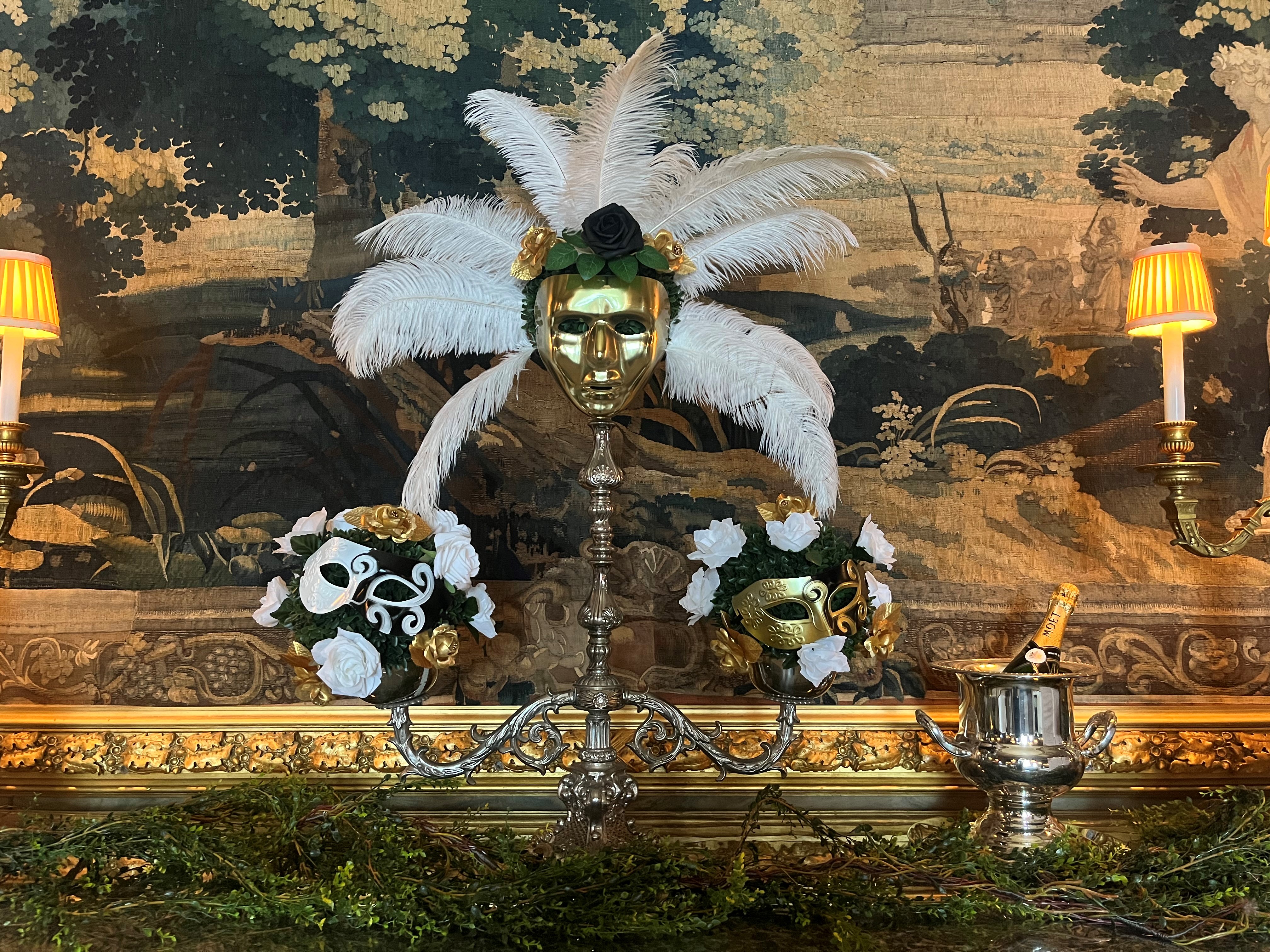
The Christmas season is always a grand affair at Staatsburgh!  The site has elaborate decorations that evoke the decadence and over-the-top nature of the Gilded Age. Quite often, the holiday decorations are aligned with a theme and in 2022 that theme was masquerade.  Masks adorned various Christmas trees and tables throughout the mansion and the strains of Phantom of the Opera's 'Masquerade' could be heard in the dining room (hence the borrowed lyric in the title of this essay.)  Masquerade balls evoke a sense of mystery and opulence that was most commonly associated with 16th-century Venice and the Carnival. Since wearing a mask could act as a disguise, there was an element of thrill and intrigue about not knowing the identity of your dance partner.  Although masquerade balls fell out of fashion the following century, they became popular again in 18th-century Europe.  Given that Gilded Age décor frequently copied 18th-century European tastes and styles, it was only natural that masquerade balls were once again part of entertaining .  

Banquet table in the Dining Room, December 2022

Tuesday, November 29, 2022

"My Dear Gitty,": What Margaret Lewis Livingston's Letters to her Daughter Reveal about the Mother of 12

Could letters serve as a gateway to the mind?  To a person's innermost thoughts and feelings?  Is it possible to peer into the psyche of a person by reading their letters?  Maybe, maybe not.  In retrospect, we cannot know how much a person pours of themselves into their correspondence.  Are they truthful or reserved?  Do they have an agenda? Did the writer consider their legacy when composing letters that would potentially shape the way they are remembered?  All of these questions come into play when historians explore primary sources such as correspondence.  

At Staatsburgh, we often lament the lack of letters and personal papers left behind by the Mills family.  While the family donated estate lands, outbuildings, the mansion and its furnishings to New York State, any personal papers were removed by the family.  Letters from Ruth and Ogden Mills do exist in the archival collections of the recipients and there is always more to find.  Even though correspondence to or from Ruth and Ogden Mills is thin, a treasure trove of letters from Ruth's grandmother, Margaret Lewis Livingston (1780-1860) exists and were recently annotated and published by Mary Mistler.  This essay will share some of the insights about Margaret's life that can be gleaned from reading through all of these letters.

The annotated book of letters from Mary Mistler and Staatsburgh's typewritten transcripts of the letters.  Mistler's book is currently available for purchase in Staatsburgh's gift shop!

Sunday, August 28, 2022

Hidden Treasures of the Collection: Brunswick Panatrope Records

Two months ago, I wrote this post about Staatsburgh's Brunswick Panatrope that is located in the Main Hall.  This music player, which dates to 1927, has one original record inside the player.  Was this disc the last piece of music the family listened to while using the Panatrope?  What else did they listen to?  I always wondered about the rest of their music collection and I am happy to report that I discovered two binders of additional records in storage!  What can these records tell us about the family's musical preferences and the role of music in their lives?

Staatsburgh's Brunswick Panatrope

Thursday, June 30, 2022

Hidden Treasures of the Collection: Brunswick Panatrope

“Without music, life would be a blank to me.” — Jane Austen, Emma

Gilded Age entertaining and music went hand in hand.  Attending the opera, musicales, or grand balls with a live orchestra was a common social activity for the Gilded Age elite.  Live music was also a frequent component of at-home entertaining.  When Ruth Mills held a reception for Alice Roosevelt on the occasion of her father's election as President, the Staatsburg Band serenaded her, and the Hungarian Band played music for the evening's dancing.

It was during the Gilded Age, that a whole new way to listen to music was developed.  Thomas Edison invented the phonograph in 1877, which was the first generally reliable device to record and play back audio.  The sound was fairly scratchy by modern standards, but the technology worked and continually improved over time.  The phonograph was a cylinder playing machine, and by the 20th century it was replaced with the disk phonographic record.  With this new technology, a machine now existed that could bring recorded music into the home and public spaces.

Thomas Edison and his second phonograph, 1878
  

Thursday, March 31, 2022

Staatsburgh & The Gilded Age

As the stewards of a site that interprets the Gilded Age, we were very excited to see an entire television series dedicated to the era.  We were especially interested because the show was created by Downton Abbey mastermind, Julian Fellowes who is known for the efforts he puts into the historical details and accuracy of his shows and movies.  The first season of HBO's The Gilded Age depicted 1882 New York and aired from January - March 2022; a second season is forthcoming.  The show brought the era to life with magnificent costuming, sets, and a dramatization of the clash between old and new monied elites.  In addition to this central clash of values, the show also depicted the life of the black elite in Brooklyn, the plight of servants, and the ways new technology was about to revolutionize the country.  Although the main characters were fictional, there were several real historical figures mixed in such as Mrs. Astor, Ward McAllister, and Mrs. Fish among others.  

Photo: HBO

Saturday, January 29, 2022

Competitive Figure Skating in the 1920s

Although most rivers and ponds are far from fully frozen in January 2022, it is possible that avid ice skater Ruth Mills was enjoying skating season in the late nineteenth century.  January is National Skating Month and a time for figure skaters to share their love of ice skating with others.  It is the perfect time to learn to skate, but in lieu of getting out on the ice yourself, let us take a look back at skating in the United States a century ago.  Given the skating background of Staatsburgh's curator (me), the subject is one of great interest and I have enjoyed researching and writing about skating these past few years! *              

Unknown skaters enjoying the ice in 1925.
Photo Source

*For more information about Staatsburgh's past programs about figure skating in the Gilded Age, take a look at this Poughkeepsie Journal article, this blog essay, or these essays on Staatsburgh's blog

Saturday, December 18, 2021

Christmas in the 1920s

Christmas as a holiday has continuously evolved over the centuries and decades, but many modern traditions have deeply seated historic roots.  Many Christmas traditions in England and America began during the reign of Queen Victoria who led the British empire from 1837-1901.  After she married Albert of Germany, many German traditions such as decorated Christmas trees became increasingly common in England and soon spread across the ocean to the United States.  Several years ago we wrote about many of the traditions that became stalwarts of Christmas during the Gilded Age (see previous Christmas essays here), but this essay looks forward to the 1920s.  The post WWI world was changing, and new technology brought a new dimension to Christmas celebrations.  But while the United States embraced the new, there was still the tendency to look backward and dream of wholesome Christmases past before the world was torn apart by war.  Christmas was a comfort and communal celebrations of the holiday served as a balm to families (Christian ones, at least) finding their place in a new decade.


Sunday, January 31, 2021

When Ice Came from the River: Ice Harvesting in Staatsburg

Before the invention of electric refrigeration, how did food and perishables keep cold, especially during the warm summer months?  The answer is ice.  Large blocks of ice cut from a river or lake during the winter would keep food items cool all summer.  But how did the ice move from the river into the home?  To answer that question, we must take a look at the ice harvesting industry, which was active throughout much of the north-east coast of the country (as well as inland, in northern states) between the 1830s and 1920s, and which was dominated for several decades by production on the Hudson River and nearby lakes.

Ice harvesting on the Hudson, 1912
Photo: New York State Archives, NYSA_A3045-78_830